Door Samples Under Real Room Light
Cabinet photography is lit to flatter. Displays are lit to sell. Your kitchen is lit by whatever window, pendant and under-cabinet strip it already has, and that mix changes a door more than most buyers expect. CasaBuilt keeps 16 sample doors, 5 of them white and 3 gray, and the whole point of having them in the room is to watch those two families survive a full day of ordinary light.
Key takeaways
- Test doors under the room's own light, not under a display fixture.
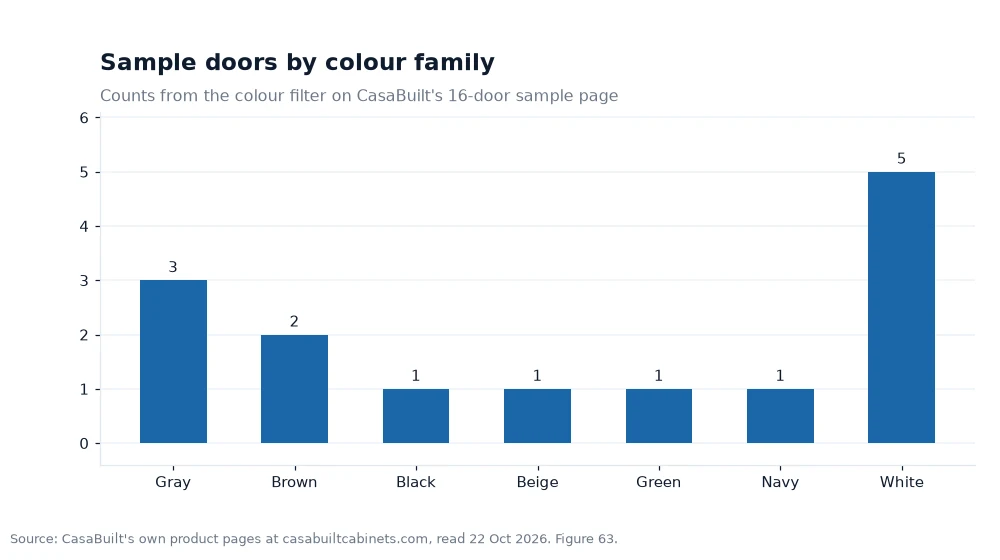
- The published sample range is White 5, Gray 3, Brown 2, and one each for Black, Beige, Green and Navy.
- White and gray make up 8 of the 16 doors, or half the range.
- Check the door at three times of day and once with the room lights on after dark.
Why display light flatters every door
A display kitchen is a stage. The lighting is placed to open shadows, lift the whites and make the countertop sparkle, and the room has no clutter, no window glare and no dark corner behind the refrigerator. A product photograph applies the same logic with exposure and color grading. None of that is dishonest, but it means the door you see online is a best-case version of the door you will receive.
The gap between best case and your case is not small. A white door that reads crisp under a cool display panel can read cream against a warm wall at home. A gray door that looks balanced in a bright studio can read green in a room with a lot of foliage outside the window. CasaBuilt sells direct, so there is no showroom visit to compare against. The sample is the only honest preview, provided it is tested where the cabinets will actually hang.
That is the rule for this article: the room is the test chamber. Every judgment happens at cabinet height, against the real wall, with the real floor underneath.
Four lights an ordinary kitchen actually has
Most kitchens have four light conditions, and they arrive in a fixed order through the day. The first is indirect morning light from a window, which is cool and soft and tends to make white doors look slightly blue. The second is direct midday sun, which is brighter and warmer and can wash out the difference between a white and a pale beige. The third is the evening pendant or ceiling fixture, which is warmer than daylight and pushes white toward cream and gray toward brown.
The fourth is the light you add yourself: an under-cabinet strip, a range hood lamp or a small lamp on a counter. These are the lights that hit the door at a shallow angle and reveal sheen, edge build and the true undertone. They are also the lights most buyers forget when they test a sample at noon and call the decision finished.
Watch what happens at the boundaries. The interesting moment is not noon; it is the twenty minutes around dusk when the window light fades and the lamps take over. A door that stays stable through that transition is a safe choice. A door that changes family is telling you it will look different in winter, when the lamps do most of the work.
Which colors move most under a lamp
The sample range is weighted toward white and gray, and those are also the families that shift most visibly under warm light, because a small change in undertone is easy to see on a pale surface. Brown and beige move less dramatically but can go muddy in a dim corner. Black and navy are the opposite problem: they absorb light and can read almost flat after dark, losing the profile detail that made them interesting in daylight.
Green is the least represented family, with a single door, and it is also the one most sensitive to the color of the light. A green that looks fresh beside a north window can look olive under a warm pendant. If green is the choice, test that one door for a full evening before ordering, and compare it with the white and gray doors at the same time so the shift is visible by contrast.
| Color family | Doors | Share of the 16 | Midday window light | Evening lamp light |
|---|---|---|---|---|
| White | 5 | 31.25% | Crisp, slightly cool | Warms toward cream |
| Gray | 3 | 18.75% | Neutral, clean | Can pick up brown or green |
| Brown | 2 | 12.5% | Rich, detailed | Darkens and flattens |
| Black | 1 | 6.25% | Strong contrast | Loses profile detail |
| Beige | 1 | 6.25% | Soft, close to wall color | Can disappear into the wall |
| Green | 1 | 6.25% | Fresh, saturated | Shifts toward olive |
| Navy | 1 | 6.25% | Deep blue, clear | Reads near black |
The counts also tell you how much choice exists inside a family. Five white doors means five chances to find the one that does not go cream at night. One black door means the decision is binary, and the test is simply whether that particular black works in your room. If white is the direction, the White Shaker cabinet page shows the assembled line the sample belongs to.
A one-day test schedule
Pick a day when you will be home. Put the doors upright on the counter at cabinet height, with the flooring visible below and the wall paint behind. At mid-morning, note which doors look cool and which look warm. At midday, check whether the sun hits the face directly; if it does, note which doors lose their detail. At dusk, turn on the lamps you normally use and repeat the note.
Then do the fourth test: turn off the overheads and use only the under-cabinet or hood light. This is the light that shows finish and edge, and it is the one that reveals whether a door has a thin coat along the stile. Order a cabinets door sample for each color you are seriously considering and run the same four notes on every one, on the same day, in the same place.
Keep the notes short: one word for the morning, one for midday, one for evening, one for the under-cabinet pass. Four words per door is enough to compare a week later, when memory has already blurred the difference.
Worked example
The chart lists the sample doors by color family in the order Gray 3, Brown 2, Black 1, Beige 1, Green 1, Navy 1 and White 5. Adding the seven values gives 3 plus 2 plus 1 plus 1 plus 1 plus 1 plus 5, or 16 doors, matching the published sample count. White is 5 divided by 16, or 31.25%. Gray is 3 divided by 16, or 18.75%. Brown is 2 divided by 16, or 12.5%, and the four single-door families are 1 divided by 16, or 6.25% each.
White and Gray together are 8 doors, or 50% of the range, which is why the neutral comparison is the one most buyers can run thoroughly. White is 5 divided by 3, or 1.67 times Gray. The three darkest families, Brown, Black and Navy, total 4 doors, or 25%. At $9.99 per door, the white and gray block costs 8 times $9.99, or $79.92, and the full range costs $159.84 before the refund. Testing all 16 under four light conditions is 64 observations, which is more than enough to see a pattern.
Frequently asked questions
Why does my cabinet sample look different at night?
Because the lamps in a kitchen are warmer than daylight, and warm light shifts pale colors toward cream and yellow. A door that looks neutral at noon can look warm after dark. Test the sample under the lamps you actually use, not only by the window.
Should I test a sample in the room or outside?
In the room, at cabinet height, against the wall and above the floor. Outdoor light is brighter but it is not the light the cabinets will live in, and it hides the very shifts that matter after dusk.
How many samples cover the color range?
The published range is 16 doors: White 5, Gray 3, Brown 2, and one each for Black, Beige, Green and Navy. Each is $9.99 and the fee is refundable with a cabinet purchase.
Let the room make the call
Put the doors where the cabinets will hang, leave them there for a day, and write four notes per door: morning, midday, dusk and under-cabinet. The door that stays recognizable in all four is the one to order, even if it lost the noon beauty contest. A sample costs $9.99 and a day of attention; a kitchen that looks wrong after dark costs considerably more.
Figures quoted here come from the manufacturer's own website, read 22 Oct 2026[1].